

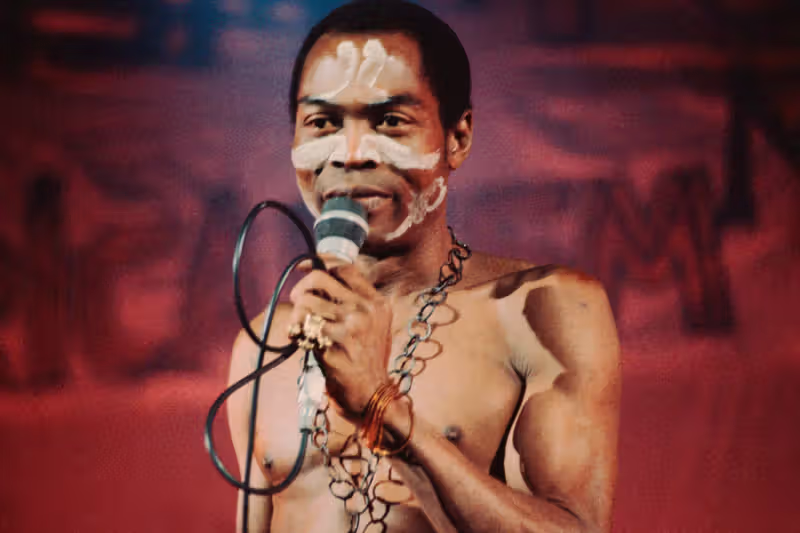
On Saturday 31 January, the Recording Academy held its Special Merit Awards ceremony in Los Angeles. The event took place the night before the 68th Annual Grammy Awards. Alongside Cher, Carlos Santana, Chaka Khan, Paul Simon and Whitney Houston, one name carried a weight all its own: Fela Anikulapo Kuti. The Fela Kuti Grammy Lifetime Achievement Award marks a historic first. No African artist had ever received this honour in its 63-year history. The recognition is monumental. It is also overdue.
The Anti-Establishment Meets the Establishment
There is deep irony here. The establishment chose to honour a man who spent his entire career fighting establishments. Nigerian military governments jailed Fela repeatedly. In 1977, nearly 1,000 soldiers stormed his commune, Kalakuta Republic, and burned it down. His mother, the activist Funmilayo Ransome-Kuti, died from injuries in that raid. Fela created Afrobeat — distinct from contemporary Afrobeats. He fused jazz, funk, highlife and Yoruba rhythms into politically charged compositions. Many stretched beyond twenty minutes. He recorded over 200 songs. But he never won a Grammy in his lifetime. He died in 1997.
His son Femi Kuti accepted the award. He told the audience: “Thank you for bringing our father here. It’s so important for Africa. It’s so important for world peace and struggle.”

A Legacy That Shaped Modern African Music
The Academy’s official citation credits Fela with influencing Beyoncé, Paul McCartney and Thom Yorke. It also highlights his foundational role in shaping modern Afrobeats. Nigerian music critic Joey Akan called the recognition a reflection of the inspiration Fela has provided for over half a century. Burna Boy, Wizkid and Davido have all sampled or referenced Fela’s work. Between Femi, Seun Kuti and grandson Made Kuti, the family holds eight Grammy nominations.
Daughter Yeni Kuti offered a personal view. She said her father would have been unfazed: “He didn’t at all care about awards. He played music because he loved music.”
The Debate Continues
Dolapo Amusat, founder of WeTalkSound, captured it well. He told the Associated Press: “Regardless of the contrast with what Fela represented and what the award represents, I think it is a net positive for African music.”
Fela’s 1976 album Zombie entered the Grammy Hall of Fame last year. The New Yorker named the podcast Fela Kuti: Fear No Man their top pick of 2025. Nearly three decades after his death, the father of Afrobeat still commands attention. He still sparks conversation. Few artists ever manage that.
